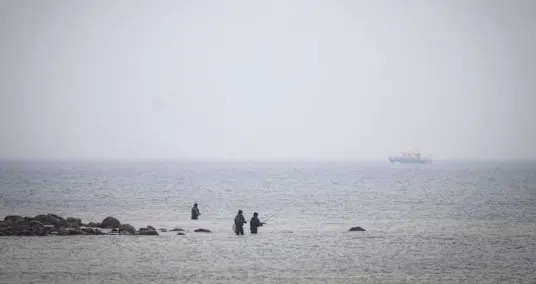
A humpback whale stranded for days off Germany's Baltic coast has gotten stuck on another sandbank, a Greenpeace spokeswoman said on Saturday.
The unlucky animal had garnered media attention for days, after it got stranded on a sandbank off Germany's Timmendorfer Strand resort, near the city of Lübeck, early on Monday.
Days of efforts to free the 12- to 15-metre whale proved unsuccessful until rescuers dug out a channel in the sand around the animal using a floating excavator on Thursday, allowing the whale to swim free the following night.
However, environmentalists and marine experts had feared that the animal could potentially get stuck again, as it was spotted heading back towards shallower water following its release.
Those fears became reality on Saturday, with the whale spotted stranded on a sandbank in the Bay of Wismar, some 40 kilometres to the east of Timmendorfer Strand, according to Greenpeace.
Large whales such as humpback whales are not native to the Baltic Sea. They may follow schools of fish in search of food and end up in the Baltic Sea.
According to experts, underwater noise could also play a role.

LATEST POSTS
- 1
 Iran war fuels fears of new inflation wave among German consumers
 - 2Interstellar comet 3I/ATLAS' journey through our solar system, in photos
- 3Picking Childcare Administrations for Your Loved ones
- 4The Solution to Defeating Tarrying: Systems for Expanded Efficiency
- 5Giant ‘toothed’ birds flew over Antarctica 40 million to 50 million years ago



- Figure out How to Stay away from Normal Handshaking Missteps
- Activists guilty over Palestine protest breach
- What to expect from the planets in 2026 — key dates and sky events
- Linda Hamilton, 69, says she doesn't want to 'chase longevity'
- 5 Wellbeing Applications Assist You With remaining Fit
- EU Commission prepares €90bn Ukraine loan despite Hungary's veto
- Interstellar comet 3I/ATLAS isn't an alien spacecraft, astronomers confirm. 'In the end, there were no surprises.'
- In vogue Sleepwear Patterns for 2024
- France bans Muslim gathering citing risk to participants